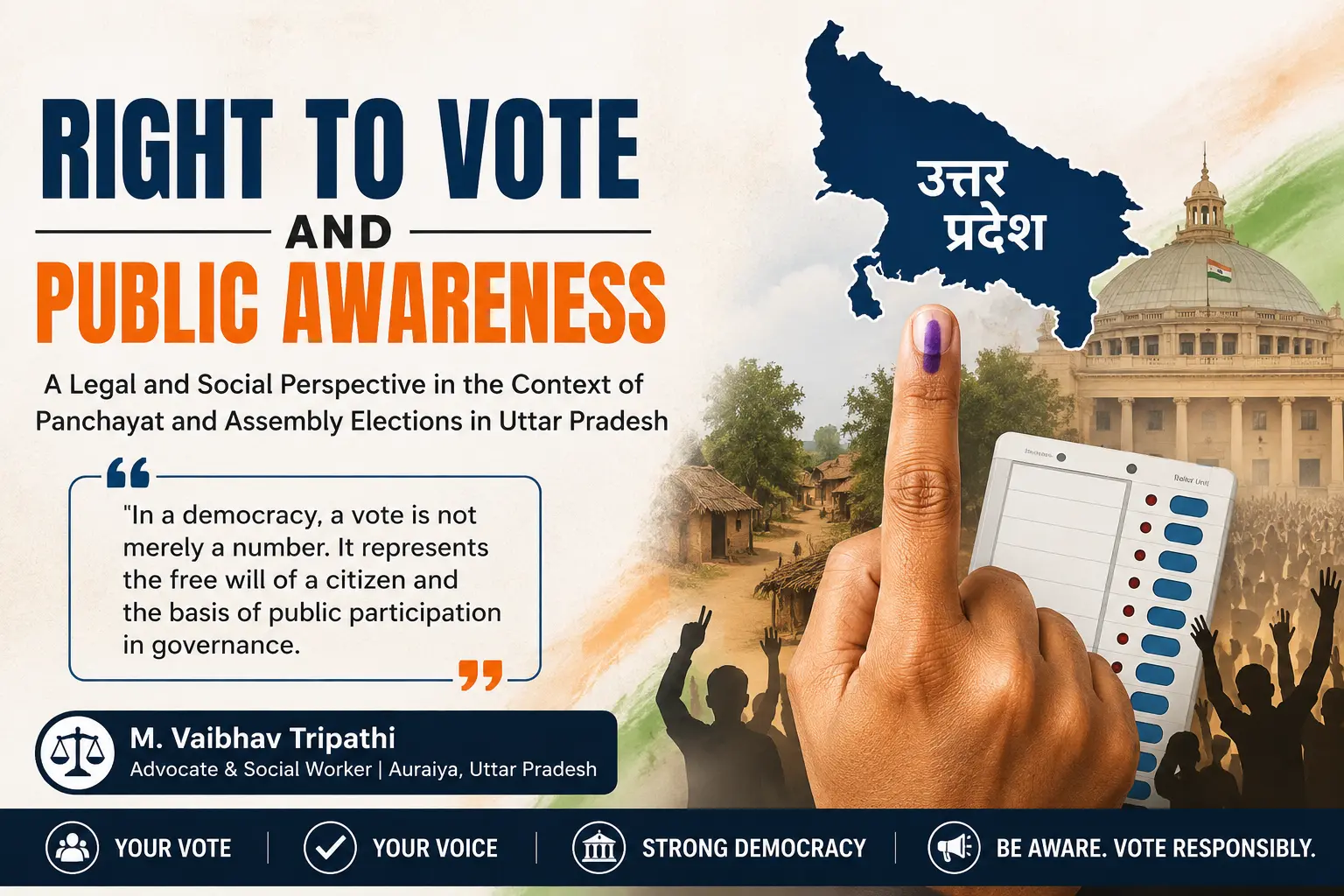
A Legal and Social Perspective in the Context of Panchayat and Assembly Elections in Uttar Pradesh
In a democracy, a vote is not merely a number. It represents the free will of a citizen and the basis of public participation in governance.
Introduction
Democracy is not merely a system through which governments are elected. It is a system in which citizens participate in the process of governance by choosing their representatives. The right to vote is therefore one of the most important means through which an ordinary citizen becomes a participant in the democratic process.
In a state as large and diverse as Uttar Pradesh, the importance of voting becomes even greater. The democratic process begins at the village level through Panchayati Raj Institutions and extends to the State Legislative Assembly. Panchayat elections determine local representation and influence the direction of development at the grassroots level, whereas Assembly elections determine the broader legislative and policy direction of the State.
In the present circumstances, therefore, the question is not merely how many people will vote. The more important question is how many people will vote with awareness, independence and proper understanding of their democratic responsibility.
Constitutional Basis of the Right to Vote
Article 326 of the Constitution of India provides for elections to the House of the People and the Legislative Assemblies of States on the basis of adult suffrage. A citizen who has attained the age of eighteen years and is otherwise qualified under law is entitled to be registered as a voter.
Article 325 further provides protection against exclusion from an electoral roll on the grounds of religion, race, caste or sex.
It is important to understand that the right to vote is generally regarded as a constitutional and statutory right rather than a fundamental right in itself. The exercise of this right is regulated by the Constitution and various electoral laws.
However, this does not diminish the importance of the voter’s freedom. Free and fair elections are an essential feature of a democratic constitutional system. A voter must therefore be able to exercise his or her vote without fear, coercion, undue influence or improper inducement.
The real value of the right to vote lies not merely in the existence of the right, but in the ability of the citizen to exercise it freely.
Why Voter Awareness Matters Today
The nature of elections has changed considerably in recent years. Political communication is no longer limited to public meetings, newspapers or local discussions. Mobile phones and social media have made every citizen both a consumer and, in many cases, a distributor of information.
A message can reach hundreds or thousands of people within a few minutes. However, the speed with which information spreads does not determine its truth.
A voter today may encounter political claims, videos, surveys, opinions and allegations through different digital platforms. Some may be genuine, while others may be incomplete, misleading or entirely false.
Therefore, a modern voter must possess not only political awareness but also the ability to distinguish between verified information and misinformation.
A truly aware voter is not merely someone who votes. It is someone who understands the importance of the vote and makes a considered decision.
Panchayat Elections and Grassroots Democracy
The strength of democracy is not tested only in Parliament and Legislative Assemblies. Its real foundation lies at the grassroots level.
Panchayati Raj Institutions provide citizens with an opportunity to participate directly in local self government. In Uttar Pradesh, elections to Gram Panchayats, Kshetra Panchayats and Zila Panchayats form an important part of this democratic structure.
Panchayat elections should therefore not be viewed merely as elections to select a village representative. They also determine the quality of local leadership, the priorities of development and the level of accountability that citizens can expect during the elected term.
The voter in a village often personally knows the candidates. This creates a unique situation. Personal relationships, family connections, social considerations and local equations can influence voting decisions.
However, democratic choice requires the voter to look beyond personal relationships and consider whether a candidate is capable of performing a public responsibility.
A personal relationship may be important in private life, but when a person seeks public office, public interest should become the primary consideration.
The Present Panchayat Electoral Context in Uttar Pradesh
The present period is particularly significant for voters in Uttar Pradesh because the State Election Commission has been dealing with Panchayat Election 2025 to 2026 related processes and Panchayat Electoral Roll 2026 related arrangements.
The official machinery provides facilities concerning electoral rolls and voter related information.
Therefore, one of the first responsibilities of every eligible rural citizen should be to verify whether his or her name is correctly included in the relevant electoral roll.
This is a simple step, but it is extremely important.
A citizen who discovers an error only on the day of polling may lose the opportunity to participate in the election.
Voter awareness must therefore begin well before polling day.
Personal Relationships and Public Interest in Panchayat Elections
Panchayat elections have a distinct social character. Candidates are often known personally to the voters. They may be relatives, neighbours, friends or members of the same social group.
These relationships naturally influence human behaviour, but voting for a public office should ultimately be guided by public interest.
The voter should ask simple questions.
Is the candidate capable of performing the responsibility?
Does the candidate understand local problems?
Does the candidate have a sense of public accountability?
Can the candidate work for the entire village rather than for a particular group?
These questions are more important than personal familiarity when the decision concerns a public office.
Assembly Elections and the Responsibility of the Voter
Assembly elections have a wider impact than local body elections. Members of the Legislative Assembly participate in the legislative process and play an important role in the functioning of the State government.
The current term of the Uttar Pradesh Legislative Assembly extends into 2027. Therefore, the coming period is likely to witness increasing political discussion and public engagement in relation to the next Assembly election.
For an Assembly election, the voter should consider issues that affect the State as a whole.
Education, healthcare, employment, law and order, agriculture, infrastructure, transportation, industrial development, welfare schemes and opportunities for young people are among the matters that may reasonably form part of public discussion.
The purpose of voter awareness is not to instruct a citizen whom to vote for. The choice must always remain with the voter.
The purpose is to ensure that the choice is informed, independent and voluntary.
Voting Beyond Caste and Emotional Considerations
Uttar Pradesh has a diverse social structure. Caste, religion, community, region and social identity are realities of society.
However, when these considerations completely dominate the electoral decision, the broader public interest may sometimes be overlooked.
A voter should therefore ask not only who the candidate is, but also what the candidate can contribute to public life.
Democracy gives every citizen the freedom to make an individual political choice. At the same time, responsible citizenship requires that such a choice be made after proper consideration.
The strength of democracy lies in the freedom of choice as well as in the maturity with which that freedom is exercised.
Money, Inducement and Freedom of Choice
The influence of money and other forms of inducement can pose a serious challenge to the integrity of elections.
A vote should never be treated as a commodity that can be purchased.
A temporary benefit cannot be compared with the long term consequences of electing a public representative.
The value of a vote extends far beyond election day. The person elected may influence public affairs for years.
Therefore, the voter should understand that the vote is not a favour being granted to a candidate. It is an exercise of democratic and constitutional participation.
Judicial Perspective on the Role of the Voter
The Indian judiciary has, on several occasions, recognised the importance of free and fair elections and the role of the voter in a democratic system.
In cases such as People’s Union for Civil Liberties v. Union of India, the Supreme Court has recognised the importance of the voter’s right to know relevant information concerning candidates.
The broader principle emerging from such judicial decisions is that a democratic voter should not be expected to make an informed choice while being deprived of relevant information.
The voter is therefore not merely a person who presses a button on the voting machine. The voter is a citizen who has the ability to consider available information and make an independent electoral choice.
Social Media and the Responsibility of the Modern Voter
The influence of social media during elections has increased significantly.
A video, message or political claim can become widely circulated within minutes. But popularity does not establish authenticity.
A message shared by thousands of people may still be false.
A viral video may lack its original context.
A political claim may be emotionally appealing but factually incorrect.
The responsible voter should therefore follow a simple principle.
See, Verify and Then Believe.
Young Voters and the Future of Democracy
Young voters represent one of the most important strengths of Indian democracy.
For a young citizen, the first vote is not merely the first opportunity to participate in an election. It is also an introduction to constitutional citizenship and democratic responsibility.
Young people should not restrict political participation to discussions on social media. They should understand the electoral process, examine public issues and participate responsibly in elections.
At the local level, young voters can play an important role in raising questions concerning education, employment, infrastructure, public services and development.
At the State level, they can contribute to broader discussions concerning policies and governance.
Your first vote should not merely be your first vote. It should be your first responsible democratic decision.
Voter Awareness Must Remain Different from Political Campaigning
In the present electoral environment, the neutrality of voter awareness is extremely important.
An awareness campaign should not become a disguised campaign for a political party or candidate.
True voter awareness means informing citizens about their rights, responsibilities and the electoral process.
A voter should know how to verify his or her name in the electoral roll, understand the voting process, obtain reliable information about candidates, recognise improper inducement, understand the importance of secrecy of the ballot and remain cautious about misinformation.
The objective should be to strengthen the voter, not to influence the voter’s political choice.
Panchayat to Assembly: One Voter, Different Responsibilities
The same citizen may vote in different elections for different constitutional and local institutions.
At the Gram Panchayat level, the voter considers local issues.
At the Kshetra Panchayat and Zila Panchayat levels, the voter considers wider local and regional development.
At the Assembly level, the voter considers the broader governance and legislative direction of the State.
The institutions may be different, but the fundamental responsibility remains the same.
The voter must exercise the vote freely, independently and responsibly.
This is the foundation of meaningful democratic participation.
Legal Awareness and Voter Awareness
Voter awareness cannot be completely separated from legal awareness.
A citizen who does not know his or her legal rights may not be able to effectively understand or use the protections available under electoral law.
Advocates, law students, legal services institutions, civil society organisations and other responsible members of society can play an important role in this field.
Legal and voter awareness programmes at the village level can help citizens understand electoral procedures, voter registration, their legal rights and the appropriate mechanisms available for raising electoral concerns.
Such initiatives should remain non partisan and focused on constitutional values.
Conclusion
Panchayat elections and Assembly elections represent two different levels of democratic participation in Uttar Pradesh.
Panchayat elections strengthen local self government and provide representation at the grassroots level. Assembly elections determine the broader legislative and governance direction of the State.
At the centre of both processes stands one important institution: The Voter.
If the voter is aware, the election becomes more than a competition between candidates. It becomes an expression of the informed will of the people.
The present circumstances make voter awareness particularly important. With Panchayat electoral processes receiving attention and the next Assembly election approaching in the broader electoral cycle, citizens must understand that their democratic responsibility begins long before polling day.
The need of the present time is not merely to increase the number of votes cast. The greater need is to increase the number of informed, independent and responsible votes.
Democracy does not become stronger merely because people vote.
Democracy becomes stronger when people understand why they are voting and exercise that choice freely.
A vote cast in a Panchayat election can influence the direction of a village.
A vote cast in an Assembly election can influence the direction of the State.
Therefore, every citizen must understand the value of his or her vote.
My vote is neither a favour to anyone nor a commodity to be exchanged. It is an expression of my free will, my constitutional participation and my responsibility towards the future.
A conscious voter strengthens the election.
An informed voter strengthens democracy.
ABOUT THE AUTHOR
M. Vaibhav Tripathi
Advocate & Social Worker
Auraiya, Uttar Pradesh
The views expressed in this article are personal and are intended for legal, constitutional and public awareness purposes.