Have you ever wondered why two competing airlines can’t openly agree to charge the same ticket price? Or why a company that dominates a market can’t simply refuse to sell to a competitor who needs its product to survive?
The answer lies in competition law in India — a set of rules designed to make sure markets remain fair, open, and competitive. The watchdog that enforces these rules is the Competition Commission of India (CCI).
This guide explains the key concepts of competition law in India, what businesses must watch out for, and what happens when you fall foul of the CCI.
Why Competition Law Exists
A free market works best when companies compete fairly. Competition drives innovation, keeps prices down, and gives consumers more choices. When companies collude to fix prices or when a dominant company abuses its market position, consumers and smaller competitors lose out.
The Competition Act, 2002 — India’s primary competition law — was enacted to prevent exactly these problems. It came into full force in 2009 with the establishment of the CCI.
The CCI’s mandate: protect competition, not individual competitors. This distinction matters. The CCI doesn’t step in every time a competitor complains about losing business — it steps in when the conduct in question harms competition in the market as a whole.
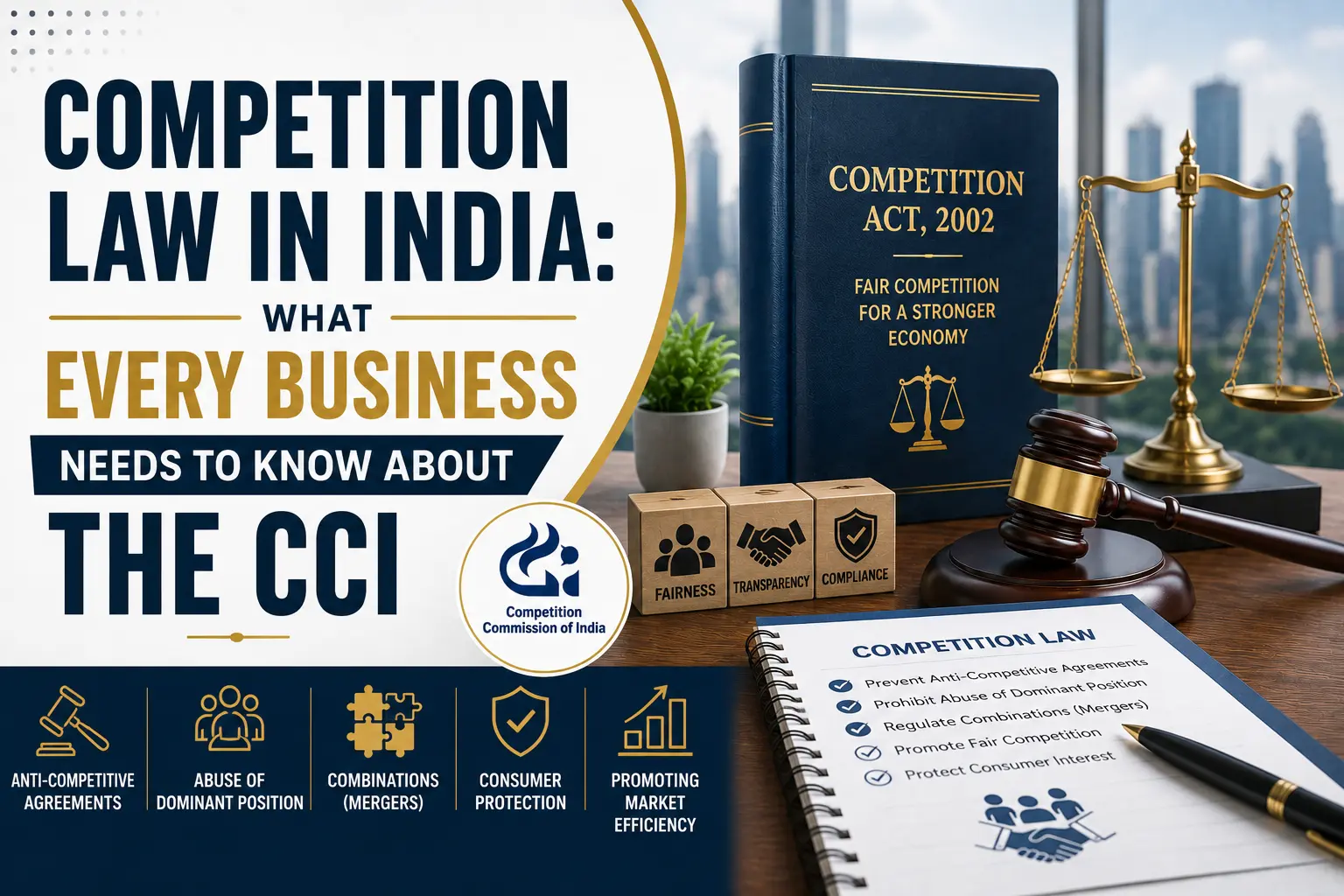
The Three Pillars of Competition Law in India
1. Anti-Competitive Agreements (Section 3)
Section 3 of the Competition Act prohibits agreements between businesses that cause an Appreciable Adverse Effect on Competition (AAEC) in India.
These are broken into two categories:
Horizontal agreements (between competitors): These are agreements between companies operating at the same level — say, two competing tyre manufacturers. Horizontal agreements that are per se void (automatically illegal) include:
- Price fixing: Agreeing to charge the same price
- Bid rigging / collusive tendering: Coordinating bids in a tender
- Market allocation: Agreeing to divide markets or customers
- Output restrictions: Agreeing to limit production
These are the most serious violations. No defence is available — they are illegal regardless of the impact.
Vertical agreements (between businesses at different levels): These are agreements between a manufacturer and its distributor, or a supplier and a retailer. Vertical agreements are assessed under the rule of reason — the CCI looks at whether the agreement actually harms competition.
Examples: Exclusive dealing arrangements, minimum resale price maintenance (telling distributors they cannot sell below a certain price), territory restrictions.
Vertical agreements are not automatically illegal. But they become problematic if they have an AAEC.
2. Abuse of Dominant Position (Section 4)
A company that has a dominant position in a market has special responsibilities. Having a dominant position is not illegal. Abusing it is.
What is a dominant position? A company is dominant if it can operate independently of market forces — meaning its decisions on price, output, or terms are not significantly constrained by its competitors.
There is no fixed market share threshold for dominance under Indian law (unlike the EU’s rough 40% benchmark). The CCI looks at market share, entry barriers, buyer power, and other factors.
What counts as abuse?
- Predatory pricing: Selling below cost to drive competitors out, with the intent to later raise prices
- Refusal to deal: Refusing to supply an essential input to a competitor without valid reason
- Tie-in arrangements: Forcing customers to buy one product as a condition for buying another
- Exclusionary conduct: Using market power to foreclose competitors from the market
- Excessive pricing: Charging unfairly high prices (rare in practice, but possible)
3. Regulation of Combinations (Sections 5 & 6)
When two companies merge or one acquires another, the deal can reduce competition in the market. CCI regulates combinations (mergers, acquisitions, and amalgamations) that cross prescribed size thresholds.
Current thresholds for mandatory CCI notification (India-specific):
- Combined assets of parties in India exceed ₹2,000 crore, OR
- Combined turnover of parties in India exceeds ₹6,000 crore
Global thresholds (if either party is outside India):
- Combined global assets exceed USD 1 billion (with at least ₹1,000 crore in India), OR
- Combined global turnover exceeds USD 3 billion (with at least ₹3,000 crore in India)
If thresholds are met, parties cannot complete the deal without CCI approval. Closing without clearance is a violation — and the CCI can impose penalties of up to 1% of the total assets or turnover of the combined entity.
Our mergers and acquisitions legal team handles CCI filings as part of all qualifying M&A deals.
CCI Enforcement: What Happens If You Violate the Law
The CCI has wide powers to investigate and punish violations.
Investigation process:
- Complaint filed by any person, company, or government body (or CCI can act suo motu)
- CCI’s Director General (DG) investigates
- DG submits report to CCI
- CCI issues notice to the parties, hears them
- CCI passes final order
Penalties:
- For anti-competitive agreements: Up to 10% of average annual turnover for the last 3 years (or 3 times profit for cartels, whichever is higher)
- For abuse of dominance: Up to 10% of average annual turnover for the last 3 years
- For procedural violations (like closing a deal before CCI approval): Up to 1% of total assets or turnover
Directors and key managerial personnel can also be held personally liable in some cases.
Leniency Programme: If a member of a cartel comes forward and discloses the cartel to the CCI before detection (or cooperates after detection), they can get a significant reduction in penalty — sometimes up to 100% for the first applicant. This is called the CCI’s Leniency Programme.
Recent CCI Trends in India
Digital markets: The CCI has been very active in digital markets. It investigated Google for pre-installing its apps on Android phones (imposed a ₹1,337 crore penalty), and Amazon and Flipkart for alleged preferential treatment of certain sellers.
Merger filings: With the 2023 amendments to the Competition Act, India has introduced a new deal value threshold — mergers where the deal value exceeds ₹2,000 crore AND at least one party has substantial business operations in India must be notified to CCI, even if asset/turnover thresholds are not met. This is particularly relevant for tech startups and digital acquisitions.
Increased timelines: CCI’s review period was reduced from 210 days to a more streamlined process, with Phase 1 clearance possible in 30 working days for straightforward deals.
What Should Your Business Do?
If you are entering into an agreement with a competitor: Be very careful about discussions on pricing, markets, or customers — even informal conversations can be evidence of a cartel. Make sure all agreements go through legal review.
If your company is in a dominant market position: Review your pricing policies, supply terms, and distribution arrangements. Conduct a dominance audit. What is standard commercial practice for a non-dominant company may constitute abuse for a dominant one.
If you are doing a merger or acquisition: Check whether your deal crosses the CCI notification thresholds early in the process. CCI review takes time. Factor this into your deal timeline. Our competition law legal services team advises on CCI filings as well as competition law compliance programmes for businesses.
If you are a victim of anti-competitive conduct: You can file a complaint with the CCI. The process is accessible to any person, company, or association. The CCI can order the offending company to modify its conduct and award compensation.
Our dispute resolution team also handles competition law litigation before the National Company Law Appellate Tribunal (NCLAT) and in appeal before the Supreme Court.
Final Thoughts
Competition law in India is no longer just for large corporations. The CCI has investigated companies of all sizes, in sectors ranging from e-commerce to real estate to education.
If your business is growing — if you’re entering distribution agreements, thinking about acquiring a competitor, or building a dominant market position — now is the right time to build competition law compliance into your operations.
At Sharma & Sharma Law Chambers LLP, our competition law team advises businesses on compliance, defends them in CCI investigations, and represents them before appellate authorities.
Contact us today for a free consultation on competition law matters.